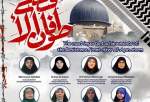
A senior member of Bahrain's Al-Wefaq Islamic Society, emphasizing that the martyred Imam Ayatollah Seyyed Ali Khamenei elevated resistance from a temporary reaction to a transnational intellectual framework, said: "His most important legacy is the revival of the thought of resistance, the strengthening of the unity of the Islamic Ummah, and the consolidation ...
A Yemeni political analyst and director of Yemen's Al-Noon Quranic Institute, says the Muslim world is passing through one of the most complex periods in its modern history, with political, military, economic, media and cultural confrontations converging into what she described as a broader struggle over people's consciousness, independence and right ...
Jihad al-Saadi, a member of the Gathering of Muslim Scholars in Lebanon, says the annual Arbaeen pilgrimage is far more than a religious occasion, describing it as the largest demonstration of the unity of the Islamic Ummah and a strategic source of strength for the Resistance.
The Executive Director of the World Union of Resistance Scholars in Lebanon emphasized that the martyred Ayatollah Khamenei transformed resistance into a comprehensive civilization-building project.
A member of the political bureau of the ‘Palestinian Struggle Movement’ said the ideas of Iran's "martyred Leader," Ayatollah Ali Khamenei, transformed the concept of resistance into a comprehensive strategy aimed at strengthening national sovereignty, empowering nations and supporting the Palestinian cause.
Prominent Bahraini scholar has emphasized the urgent necessity of elucidating the intellectual and strategic vision of the late Leader of the Islamic Revolution, Ayatollah Seyyed Ali Khamenei, for the younger generation of Muslims worldwide.
An Islamic researcher from Syria stated that the martyred leader of the revolution did not view resistance merely as a military issue, but rather emphasized its educational dimension.
In a specialized meeting hosted by the Iranian Cultural Chancellery in Manila, the personality and intellectual dimensions of a leadership model were discussed, with an emphasis on culture, justice, and foresight.
The Secretary General of Hezbollah resistance movement, Sheikh Naim Qassem, has stressed that the recent ceasefire in Lebanon was achieved only through the steadfastness of the group and support of the Islamic Republic of Iran during Pakistan talks.
Hazem Qassem, spokesman for the Islamic Resistance Movement (Hamas), stated that the weapon of the Palestinian resistance is legitimate, saying: "Raising the issue of the resistance's weapon in this manner and linking it to all tracks contradicts the provisions of US President Donald Trump's plan, especially in relation to its second phase."
A member of the Assembly of Muslim Scholars in Lebanon has emphasized that supporting the Resistance is not merely a slogan, but a stance of solidarity with those who have sacrificed their lives to uphold dignity, sovereignty, and to prevent aggression against the homeland, citing Gaza as a testament to this truth.
Sheikh Ali Damoush, head of Hezbollah’s Executive Council, emphasized that the party remains committed to its legitimate right to confront Israeli aggression, stressing that resistance will continue to be a symbol of Lebanon’s dignity and pride.
Participants at the first conference of Iraq’s Tribal Support Front reaffirmed their allegiance to the Resistance, while expressing appreciation for the Al-Nujaba Movement and its Secretary-General, Sheikh Akram al-Kaabi.
The director of the Al‑Zaytouna Center for Studies in Beirut emphasized that the Israeli regime will never be able to eradicate the Palestinian resistance.
A senior Hamas official rejected any agreement on disarming the resistance, stressing that the movement has never, at any stage, agreed to surrender or disarm the resistance in any form.
The anniversary of the martyrdom of Lieutenant General Qassem Soleimani offers an opportunity to revisit his role in fostering stability, managing regional crises, and shaping a model that remains essential for understanding developments in West Asia.
The interim Friday Prayer Leader of Khoy stated: “Haj Qassem Soleimani was the commander of resistance, and he succeeded in institutionalizing the idea of standing against global domination across the world. His intellectual and practical school of thought was inspired by Ashura and Imam Hussein (AS), serving as a model and exemplar for all freedom‑seeking ...
The Chief of Staff of the Armed Forces emphasized that the path of General Qassem Soleimani will undoubtedly continue, and the “Soleimani Doctrine” will remain an inspiration for nations that regard freedom, dignity, and independence as their inherent rights.