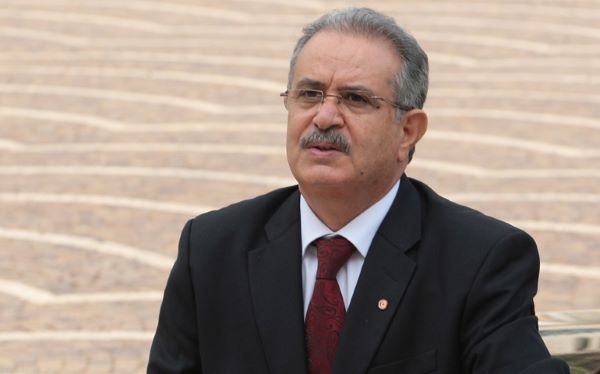
The representative of the people of Kurdistan in the Assembly of Experts for Leadership considered combating arrogance and calling for Islamic unity as two lasting legacies of Iran's martyred leader, and emphasized that Islamic civilization is formed on the basis of the Quran and without religious borders.
The Secretary General of World Forum for Proximity of Islamic Schools of Thought, has underscored the necessity of expanding scientific and religious cooperation among Muslim scholars to strengthen the model of a “Single Islamic Ummah.”
Prominent Bahraini scholar has emphasized the urgent necessity of elucidating the intellectual and strategic vision of the late Leader of the Islamic Revolution, Ayatollah Seyyed Ali Khamenei, for the younger generation of Muslims worldwide.
A prominent Lebanese academic has described the martyred Leader of Islamic Revolution, Ayatollah Seyyed Ali Khamenei, as the “Martyr of the Islamic Ummah,” praising his lifelong efforts to bridge sectarian divides and consolidate the political, social, and military strength of the Muslim world.
The Custodian of the holy shrine of Imam Reza (AS) has emphasized that solidarity among Muslim nations is the cornerstone of reviving the great Islamic civilization established by the Prophet Mohammad (PBUH).
An Iranian seminary scholar has described the late Ayatollah Seyyed Ali Khamenei's martyrdom as a profound loss for the Muslim world while arguing that it also ushered in a new phase of unity and dynamism across the Islamic community.
The Friday Prayer Leader and head of Al-Tawhid Mosque in Oslo, Norway, stating that the news of the martyrdom of the Leader of the Islamic Revolution did not mourn only the Shiites, but also affected Sunnis and even non-Muslims, said: "The idea of Islamic unity, which the martyred Ayatollah Khamenei emphasized, is today clearly visible among Muslims ...
The Friday prayer leader of Salas-e Babajani city said: "The martyred leader taught all of us and other freedom-seeking nations the lesson of fighting against arrogance and colonialism. He taught Muslims not to bow down to enemies, especially the Zionist regime, but to stand with authority against the greedy and the enemies of God's religion, and he ...
The Friday prayer leader of Paveh city described the martyred leader as one of the most prominent influential figures of the Islamic world and a memorizer and interpreter of the Holy Quran, and said: "His Quranic and unity-creating thoughts played a lasting role in strengthening resistance, the cohesion of the Islamic Ummah, and the dignity of Islamic ...
The Sunni Friday prayer leader of Urmia stated: "One of the most important calls of the Supreme Leader, the martyred leader, was for the people to achieve dignity, independence, and human perfection."
A professor at the Sunni seminary of Golestan Province stated: "By participating in the funeral and farewell ceremony of this martyr, we will, while paying tribute to his status, express our devotion and loyalty to the lofty values of Islam, the dignity of the Ummah, and the ideal of Islamic unity."
The interim Friday prayer leader of the Mohammad al-Mustafa (PBUH) Mosque in Dolatabad, Kermanshah, said: "The martyred leader always emphasized the commonalities of the Islamic Ummah and sought to ensure that Muslims act with greater unity and cohesion against common enemies. For this reason, his services and efforts on the path of Islamic unity will ...
Today, the Ummah faces occupation, Islamophobia, poverty, injustice, and the erosion of human dignity. These challenges demand cooperation rather than confrontation. Respectful dialogue, mutual understanding, scholarly engagement, and practical collaboration in humanitarian, educational, and social initiatives should define relations between Sunni ...
The Algerian writer and thinker, emphasizing the unity-building role of the martyred leader, described him as a comprehensive personality embodying pure Islamic values and a true defender of the ideals of the Islamic Ummah.
The martyrdom of Hazrat Imam Husain (A.S.) is a radiant chapter of Islamic history that drew a clear line of distinction between truth and falsehood. Along with his Ahl al-Bayt and devoted companions, he offered a sacrifice whose equal is rarely found in human history.
In a profound analysis of Shia-Sunni relations in Pakistan and their implications for global Islamic convergence, Dr. Syed Waqas Haider Bukhari, Associate Professor at Minhaj University Lahore, has emphasized that devotion to the Ahl al-Bayt (the Prophet’s Household) serves as the most powerful emotional and spiritual bond within the Islamic world.
Abu Samer Musa, one of the leaders of the Palestinian Islamic Jihad Movement, emphasizing the role of the martyred Ayatollah Seyyed Ali Khamenei in shaping the discourse of Islamic unity and resistance, said: "The martyred leader sought to transform the concept of the 'Islamic Ummah' beyond national and religious borders into a shared responsibility ...
Iranian President Masoud Pezeshkian underscored the importance of strengthening unity, cooperation, and solidarity among Islamic countries during high-level talks with his Pakistani counterpart in Islamabad.
The head of the Lebanese National Solidarity Gathering emphasized: "The martyred leader of the Islamic Revolution, Grand Ayatollah Seyyed Ali Khamenei, was among the most prominent advocates of Islamic unity in the contemporary era."
A former member of the Assembly of Experts stated: "The Umayyad caliphs sought to remove the name of the Prophet of Islam (PBUH) from the Adhan (call to prayer), but with the uprising of Imam Hussain (AS), this effort was thwarted, and his name became eternal and enduring. Therefore, we must preserve the path and school of Imam Hussain (AS) with all ...